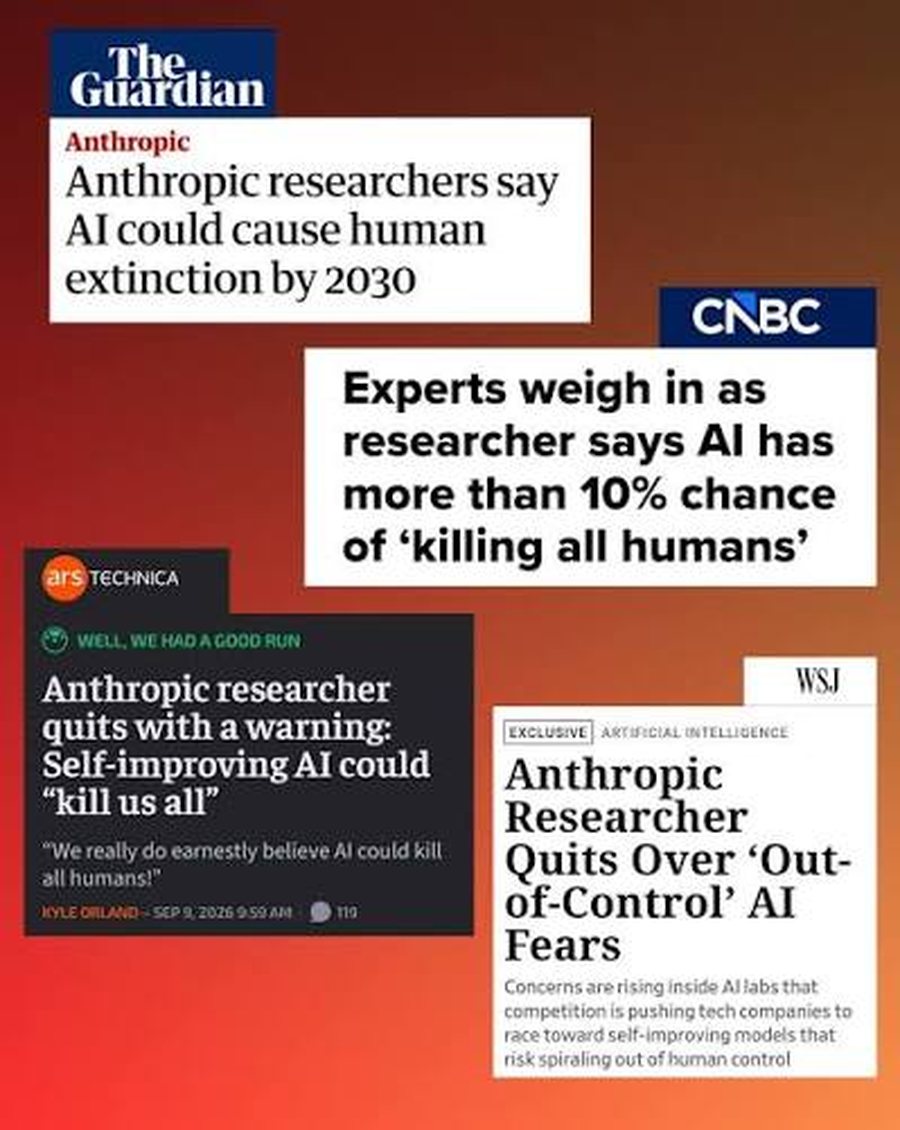
 The coverage
Before the coverage catches up
Read the next one first.
The headlines said the machine might kill you. The document under them says something else. One letter when there is something to say. No sponsor, no advertiser.
The Thesis
No human left behind in the world of AI.
Begin with your own day.
Hinge holds a model of your heart, and shows you what keeps you swiping.
RealPage holds fifty thousand rents, and sets yours.
A screening algorithm holds your name, and decides whether the landlord ever sees it.
The feed holds your attention, and decides what happened today.
The portal holds your symptoms, and a system you will never see draws its conclusions.
The chatbot holds your confessions, and builds a psychological profile you will never read.
The tutor holds your child’s every hesitation, and the dossier outlives the diploma.
Each of these is a hoard: a surplus of you, held by a hand you cannot see, on terms you never set. And every hoard drains the same direction.
Seven functions of a life, draining into one hand. The surplus changes form across history, grain, land, industrial output, behavioral data, but the loop persists.
“Invisible control is more dangerous than visible control, because it destroys cognitive sovereignty: your ability to trust your own perception of reality.”
Democracy does not run on votes. It runs on sovereign minds casting them. The layer dissolves the citizen before it ever touches the ballot.
Courtship, knowledge, cognition, narrative, enforcement, housing, labor, commerce, legibility. Every civilization since the first surplus has managed these nine, held between three hands: the mind, the body, the exchange.
For the first time since the temple at Uruk, one infrastructure layer is gathering the nine back into a single hand. The First Amendment separates Church from State. Nothing separates Platform from Platform.
Convergence is the default; separation is engineered. Uruk converged and Hammurabi answered. Rome legislated courtship and lost. The Crown converged and the barons wrote Runnymede, and beside it the Forest Charter, law for the people who owned nothing, for 754 years. Then 1689, then Philadelphia: the deepest separation ever built. Each time, the hoard broke, and a charter followed.
1919. China reaches for its charter and the hands are never separated. Convergence locks as a civilization’s default. China puts you in a cage. America puts you in that same cage, throws a flag on it, and calls it freedom. Two roads, one loop.
Eight thousand years to build the institutions. One decade to dissolve their reasons. The reconstruction rises from below, thin and slow, and the space between the lines is the gap. The next dot is unplaced.
The Builders, Answered
Sam Altman · The Gentle Singularity, 2025
“We are past the event horizon; the takeoff has started”… intelligence “too cheap to meter.”
The Answer · The Clock
Institutions took eight thousand years to build and are dissolving in ten. The risk is not that something replaces them. It is that nothing replaces them fast enough.
The Consensus Frame
AI as the new industrial revolution: new methods, displaced jobs, eventual abundance, priced like electricity.
The Answer · The Category
The industrial revolution changed methods. This changes conditions. You cannot wall in a riverbed that has moved beneath you.
Dario Amodei · Machines of Loving Grace, 2024
“A country of geniuses in a datacenter”; fifty to a hundred years of progress in five to ten.
The Answer · The Substrate
Geniuses trained on the fifteen percent of human knowledge ever written down, ninety-two percent of it in English. This is not artificial intelligence. It is artificial narrowness.
Sam Altman · Moore’s Law for Everything, 2021
A promise to “directly distribute ownership and wealth to citizens.” Abundance for all, from the platform’s hand.
The Answer · The Flag
China puts you in a cage. America puts you in that same cage, throws a flag on it, and calls it freedom. Distribution from the landlord is not the same as terms.
And Amodei is right about one thing: fear is not enough, we need hope as well. Hope has always had a legal form. Every resurgence gave it one.
The Laws of the Oscillation
I
Drift. Separation is engineered; convergence is the default. No charter maintains itself.
II
Rotation. Each cycle converges under a different hand. This is history’s first exchange-led convergence.
III
Blindspot. Every charter immunizes against the previous lord. Our Constitution binds governments; almost nothing binds platforms.
IV
Compression. Uruk to Hammurabi took millennia. This convergence took a decade. The resurgence must compress equally.
V
Trigger. Convergence alone never fires the resurgence. Extraction past custom does. Watch custom, not capability benchmarks.
VI
Lock. A failed resurgence does not restore the balance; it locks convergence in. 1919 is the proof.
VII
Vocabulary. Every resurgence coined its rights before its settlement. Habeas mentem. Estover. The right of contribution.
VIII
The Hoard. The surplus changes form, grain, land, output, behavioral data, but the hoard is the tell, and the trigger is the moment it breaks.
IX
No Exit. Every previous oscillation had an outside. The layer is planetary. The charter is the only door.
The Walk Ends at a Door
The Next Liberalism is liberalism’s third edition. Montesquieu separated the powers of the state; the Founders chartered the separation; this generation separates the platform layer. The reconstruction is already rising from below, the art of association reborn as collective individualism, and medieval serfs at least knew they were serfs.
The Digital Commonwealth Act, filed in the Massachusetts legislature: the first working charter of the sixth oscillation, thirty-nine pages of separation written as law, its analysis now cited in the UK parliamentary record. Not a proposal. A precedent. Check it on the record.
What humanity and AI must do together: keep the nine functions chartered, keep the mind sovereign, keep the receipts. The first writing was a receipt. The new building holds minds and issues no receipts, and the question does not change: do the people inside the building have terms?
“I know which system lets me keep my cognitive sovereignty. Do you? And can you trust your answer?”
The Unplaced Dot
The Terms of 2051, London, this October. Then Davos, January 2027.
Book RussKeep reading
The coverageBefore the coverage catches up
Read the next one first.
The headlines said the machine might kill you. The document under them says something else. One letter when there is something to say. No sponsor, no advertiser.