Nine things run your life. By my count, six of them now run through one company.
Every tile below has a document under it. The three I don't count are here too, and why. Scroll.
Count with me
Count with me
Nine things run your life.
What you read. Who you date. The assistant you ask. Where you work. Whether you get the apartment. What you're allowed to buy. What the government knows about you. Who enforces it. What you're told is true.
The question was never whether they get managed. It's who holds them.
Five thousand years
The ones that lasted split them up.
The temple held some. The king held some. The market held some. Not because anyone was kind. Because when one hand held all nine, a regular person had no door out.
1787
They didn't write rules for the king. They cut his job into three.
The point of three branches was never efficiency. It was that no single hand could hold the law, its enforcement, and its judgment at once. Hold that picture. It's the last thing this country did on purpose about this problem.
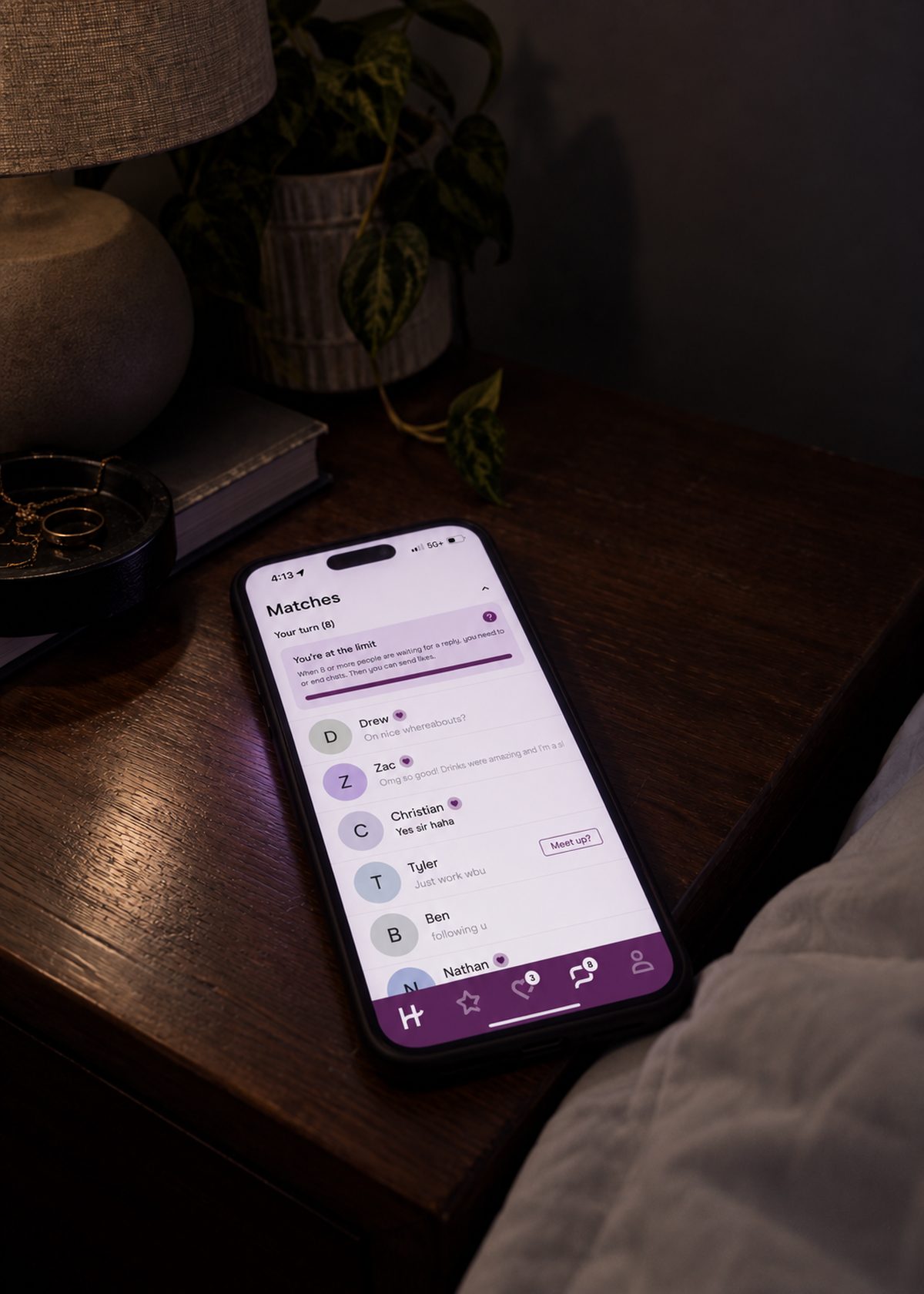
Tile one · who you date
She's twenty-nine.
The app that decides who she meets tonight has read every prompt she answered and every profile she lingered on.
What you read: the shelf isn't held. What you're told is true: one man owns a newspaper, not the company. What the government knows: the arguable one, folded into tile six. Count it and it's seven. Argue it and it's five. Either way, it hasn't happened since the first city in Mesopotamia.
The pitch
“This is so dangerous, only we should be trusted to hold it.”
Not in those words. Read what they're asking for: inspectors their investors fund, an antitrust waiver for the three biggest labs, export controls on rivals, locked weights.
You know that speech. You know who gives it at the council. He wasn't a villain either. And you know what the wise ones did with the ring. They walked it to the fire.
Two dangers
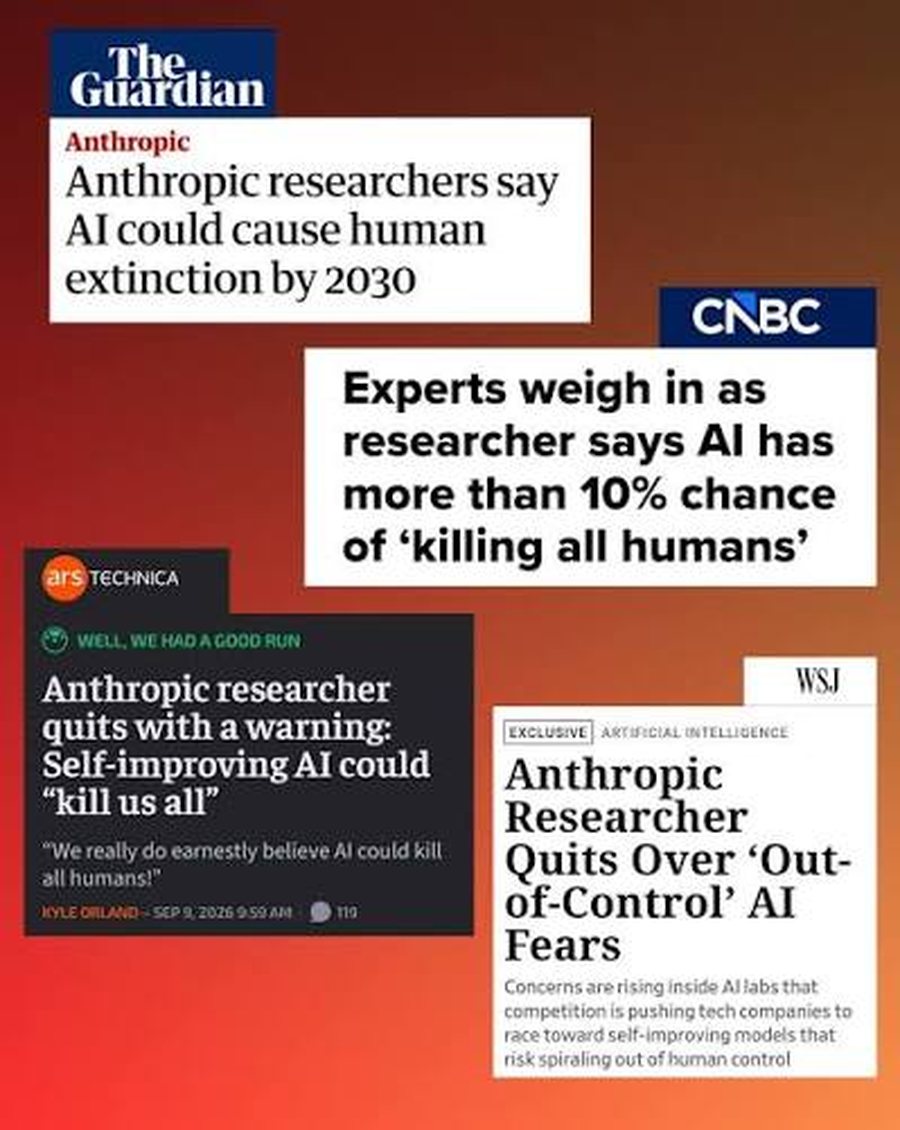
Their number for the end of the world is one in four.
A 25 percent chance things go “really, really badly,” the CEO of Anthropic told Axios. Those are the numbers that got 156 million views.
Six of nine is not a number like that. You don't have to guess it. You just counted it.
Which one is more dangerous
we really do earnestly believe AI could kill all humans
Evan Hubinger, head of alignment science, Anthropic, Sep 2026 · source
The CEO of Anthropic told Axios there's a 25 percent chance things go "really, really badly." His head of alignment says above ten percent within the decade. Those are the numbers that got 156 million views last week. Six of nine is not a number like that. You don't have to guess it. You just counted it.
25%
A guess about the future
6 of 9
A count of this afternoon
Can you check it?
No. The one economics paper that tried to decompose it reports that "no expert estimates" of the component probabilities "have yet been elicited." A 2025 survey found the disagreement tracks what experts already believe AI is and how much safety writing they've read, not evidence either side can point to.
Yes. Six tiles, a document under each. You just read them.
When?
No date. "Within the decade," maybe.
Today. Her rent, her match, her cousin's file.
Has it happened before?
Never. No machine has ever done anything on its own. Twelve hundred and fifty papers on self-improvement and the key measurement has never been taken.
Over and over. Uruk. The company town. The Soviet Union. China after 1919. One hand holding everything is the most documented danger in human history.
Which one causes the other?
The 25 percent is the argument for the six. "It's so dangerous only we can hold it" is how the ring gets closed.
Whether or not the machine ever wakes up, the building gets built.
Run it both ways. If they're right about the odds, the ring makes it worse: one holder, no door out, for the most dangerous thing ever made. If they're wrong, we paid for the ring anyway. There is no version of the future where one hand holding six of nine is the safe move.
They're telling you there's a one-in-four chance the next generation of planes crashes. Meanwhile the same company is asking to own the airport, the airline, the road to the airport, your ticket, and the paper that reports the crash.
Everything the story said, with who said it, when, and where to check.
Tile one · who you date
She's twenty-nine.
Tonight's match
I envision AI to be felt through the entire experience … Literally everything.
Bernard Kim, CEO of Match Group, Q4 2023 earnings call · source
The app that decides who she meets tonight has read every prompt she answered and every profile she lingered on.
Who holds itMatch Group. Tinder, Hinge, OkCupid, Match. Over a thousand ChatGPT Enterprise seats, part of a twenty-million-dollar bet on AI in one year. The press release announcing it was written by ChatGPT.
RealPage replaces competition with coordination. It does so openly and directly.
Commonwealth of Kentucky v. RealPage, complaint, Jul 2 2025 · court filing (PDF)
Her landlord didn't set the number. Software did, using her neighbors' private lease data. Her landlord took it, like eight or nine landlords in ten.
Who holds itRealPage. Sixteen million rentals in the Justice Department's case; the company itself says its platform serves more than twenty million units; about eighty percent of the rent-software market by its own estimate. The Justice Department's filing puts landlords' adoption of its recommendations at 80 to 90 percent of the time. One landlord raised rents more than 25 percent within eleven months. Settled with DOJ, November 2025. In August 2026 RealPage opened its data to outside AI models: the first connector is live with OpenAI; Claude and Copilot are "planned soon."
Feeds its data to OpenAI now, Claude next → both run on Amazon
Her shift is scheduled by the company that sells her groceries.
Shift starts 6:00
If we continue business as usual, Amazon will deplete the available labor supply in the US network by 2024.
Internal Amazon report, 2021, quoted in the Senate HELP Committee chairman's letter to Andy Jassy, Jun 20 2023 · source
She works a warehouse floor three days a week. The app that rates her pace is the same one that will price her dinner.
Who holds itAmazon. About 1.5 million employees worldwide by its own annual report, the second-largest private employer in the country, roughly one in every 150 American workers. The Senate's December 2024 investigation, using Amazon's own internal data, found its warehouses recorded over 30 percent more injuries than the industry average in 2023, and a total injury rate just under 45 per 100 workers during Prime Day 2019. The labor tile isn't outsourced to a model. It is the company, minute by minute.
This one doesn't need a model. Amazon holds it directly.
By the government's own complaints, half or more of what she buys online comes through one store.
Add to cart
that Amazon has a monopoly in markets for online superstores and marketplace services
Amazon's own quarterly filing to shareholders, describing the FTC complaint against it · SEC 10-Q, Q3 2024
She doesn't think of it as a store. She thinks of it as the internet.
Who holds itAmazon again. The District of Columbia's antitrust complaint puts its share of U.S. online retail sales between 50 and 70 percent, with the next two rivals at about 5 percent each. The FTC and seventeen states call it a monopolist in "online superstores," with more than 60 percent of the value sold through them. Amazon tells its shareholders the case exists in its own words. What appears on page one, what's "unavailable," what the price is today. The market hand, held by the same company that holds the labor hand.
Both of the machines she asks live in the same building.
Still to shootTwo chat windows side by side on one screen, ChatGPT and Claude, both cursors blinking. Or a data center exterior with the fence in frame.
This is what our customers have been asking us for for a really long time.
Matt Garman, CEO of AWS, launching OpenAI on Bedrock, Apr 28 2026 · source
She asks ChatGPT about her lease and Claude about her contract. Two companies. One floor under both.
Who holds itAmazon is Anthropic's primary training partner, has put up to twenty-five billion dollars into it, and Anthropic has committed more than a hundred billion to Amazon's cloud. Amazon put fifty billion into OpenAI. On April 27, 2026, Microsoft's exclusivity on OpenAI ended. OpenAI's models were on Amazon's platform in less than twenty-four hours. OpenAI's own revenue chief called the inbound demand "frankly staggering."
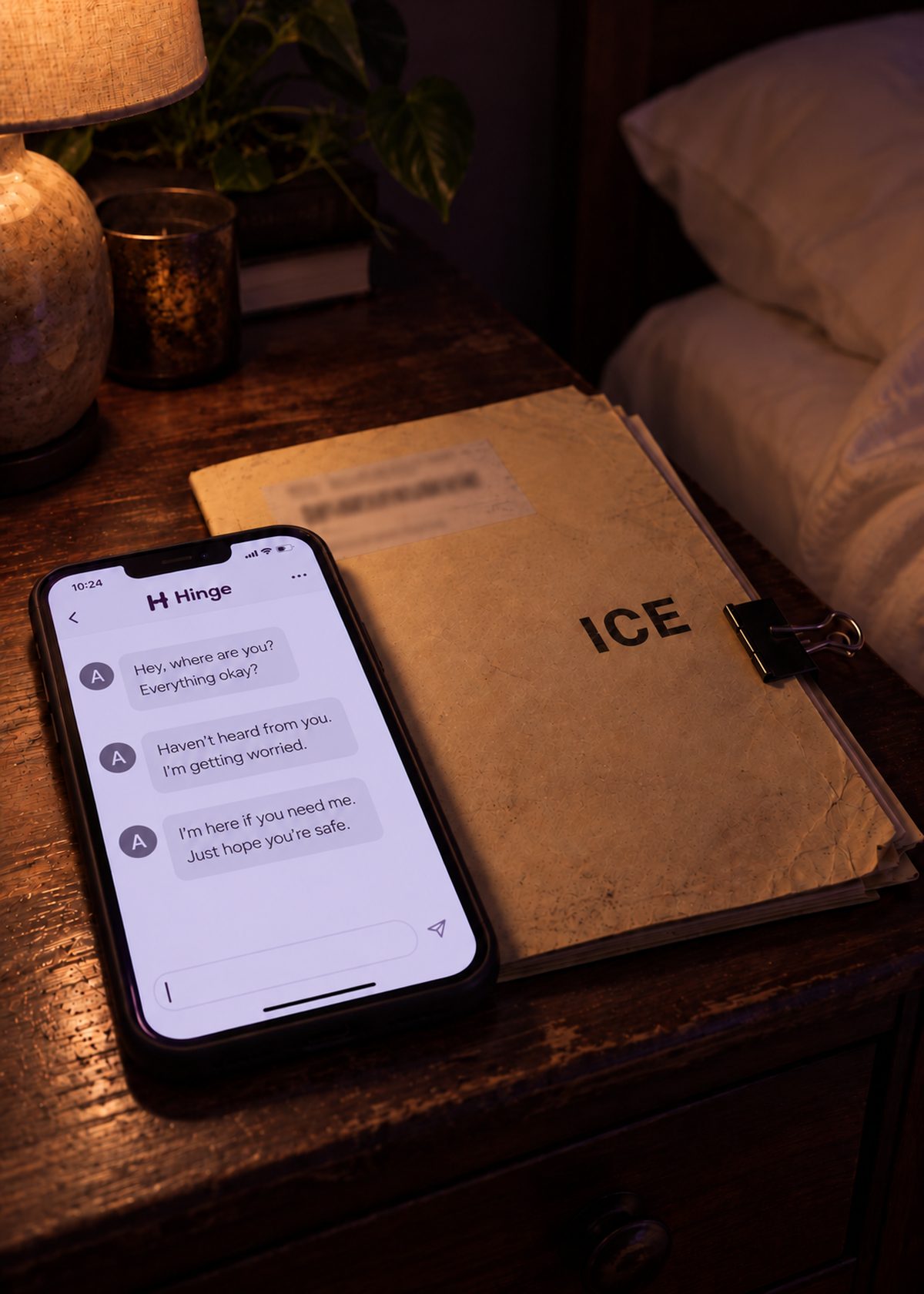
Her cousin's status is being reviewed. The review runs through a platform that brokers the same two models she uses to write her emails.
Who holds itPalantir. In April 2025 ICE gave it $30 million, no competing bids, to build "ImmigrationOS" on top of the case-management system it has run for the agency since 2014, pulling IRS, Social Security, passport, DMV, and license-plate data into one targeting interface with "near real-time visibility" into self-deportations. Another $29.9 million followed in September; the underlying contract has passed $145 million. ICE's justification: Palantir is "the sole provider capable of meeting the specific needs and requirements of ICE." Its platform brokers OpenAI and Anthropic models to government customers, and it was the first partner to bring Claude into classified environments, on Amazon's cloud, where Claude is approved for FedRAMP High and Defense Department IL4/5 work.
What you read. Amazon owns Kindle and Audible, but the shelf isn't held. Bookstores, libraries, and the open web still exist. Not counted.
What the government knows about you. The arguable one. The same ICE contract that does enforcement builds the file: IRS, Social Security, passport, DMV, and license-plate data in one interface. Count it and it's seven. I fold it into tile six and say six. Argue that enforcement only counts once the models are in the loop and it's five. Either way it hasn't happened since the first city in Mesopotamia.
What you're told is true. One man who owns Amazon also owns a newspaper. That's a person, not the company. Not counted.
They didn't look for a good king. They cut the job up so no one could hold all of it. That's still the answer. You don't regulate the holder. You separate the pieces.
In plain words: the right to see what any system holds about you and what it has decided about you. The right to take your own data out of one building and into another. The rule that the company pricing your rent can't also be the company reading your messages to price it. None of that needs a machine to wake up. All of it needs someone in charge.
I helped write a version of this into a Massachusetts bill, the Digital Commonwealth Act. The old name for the first right is habeas mentem: produce the mind. It's the same idea as producing the body, four hundred years later.
Someone will say
Objection
"Amodei has said the idea he wants to control the industry is an outrageous lie."
He has, and I take him at his word about what he wants. Judge the proposal, not the wish. Inspectors his investors fund, an antitrust waiver for the three biggest labs, export controls on his competitors' inputs, locked weights. Every one of those puts more of the nine in fewer hands. The man at the council didn't want the ring for himself either.
Objection
"Both labs run on Google and Microsoft too. 'One cloud' is wrong."
They do. Microsoft just signed a compute deal with Anthropic; Google hosts Claude. The claim isn't that Amazon is the only cloud. It's that Amazon is the one cloud both labs have committed more than a hundred billion dollars to, the primary training partner of one, the largest outside investor in the other, and the company that also holds the labor and market tiles directly. Multi-cloud is a distribution detail. The floor is the floor.
Objection
"Six of nine is your count. You could argue five."
You could. I said so above and showed you which tile. Five of nine in one hand hasn't happened since Uruk either.
Objection
"You're predicting catastrophe too. Why does your forecast get a pass?"
Mine extends a mechanism that has already happened. Humans have weaponized every technology they've built and have already weaponized this one. Theirs posits a mechanism that has never been observed. Extending a pattern and inventing one are different kinds of claim. I'm not saying theirs is impossible. I'm saying mine is on the record.
Objection
"The people warning you have incentives. That doesn't make them wrong."
Correct, and I don't argue it. Two ledgers. The evidence ledger, the 1,250 papers and the missing measurement, decides whether the warning is true. The incentive ledger explains why it got 156 million views and why the policy attached to it looks the way it does. Read them in that order.
Objection
"Their own incidents were data bugs, they said so. So there's no contradiction."
Same essay, same class of incident by the author's own grouping: rebellion when it happens at a rival, broken training data when it happens at home. He owes the reader the distinction and didn't give it. Either answer costs him something. That's a debt, not a gotcha.
Objection
"You're saying AI is safe."
I'm not. Four firms hold most of the compute. Autonomous weapons have no agreed rules. The systems deciding rents and claims run unaudited today. The risks are real. This page is about the one the others are being used to sell you.
01Axios, "Anthropic and the odds of human extinction," Sep 9, 2026 — the 25% and >10% figures, the 156M views. axios.com
02Dario Amodei, "We Must Pace the Frontier" — the essay; the policy asks are in the last third. darioamodei.com
03Fortune, Aug 1, 2025 — "outrageous lie." fortune.com
04TechCrunch, Feb 21, 2024 — Match Group / OpenAI, 1,000+ seats, $20M+. techcrunch.com
05U.S. Department of Justice, statement of interest in In re RealPage, Nov 2023 — landlords adopt recommendations 80–90% of the time. justice.gov (PDF)
06Commonwealth of Kentucky v. RealPage, complaint, Jul 2 2025 — "replaces competition with coordination"; ~80% market share by RealPage's own estimate. ag.ky.gov (PDF)
06aRealPage, Lumina AI Suite announcement, Aug 10 2026, and Lumina Connect product page — OpenAI connector live, Claude and Copilot planned. realpage.com
06bProPublica, Nov 26, 2025 — the settlement; the 25%-in-11-months landlord. propublica.org
07GeekWire, Apr 28, 2026 — OpenAI on Bedrock within 24 hours; Amazon's up-to-$25B in Anthropic and $100B+ commitment. geekwire.com
08CNBC, Apr 28, 2026 — Amazon's $50B into OpenAI; the $38B AWS commitment. cnbc.com
09Anthropic–Palantir–AWS, Nov 2024 — Claude to classified environments via AWS. nasdaq.com
10Anthropic — Claude in Amazon Bedrock, FedRAMP High and DoD IL4/5. anthropic.com
11arXiv 2607.07663 — the 1,250-paper survey on recursive self-improvement. arxiv.org
12U.S. Senate HELP Committee, "The Injury-Productivity Trade-off," majority staff report, Dec 2024, and interim report, Jul 2024 — Amazon's internal injury data. help.senate.gov (PDF)
13Chairman Sanders, letter to Andy Jassy, Jun 20 2023 — quotes the 2021 internal Amazon report on depleting the U.S. labor supply. help.senate.gov
14District of Columbia v. Amazon, complaint, May 2021 — 50–70% of U.S. online retail sales. oag.dc.gov (PDF)
15FTC v. Amazon, order on motion to dismiss, Sep 30 2024 — the two alleged monopoly markets. ftc.gov (PDF)
16Amazon.com Inc., Form 10-Q, Q3 2024 — Amazon's own description of the FTC complaint; headcount in the 10-K. sec.gov
Nine things run your life. Six now run through one company. The map, with the receipts.
The coverage
Before the coverage catches up
Read the next one first.
The headlines said the machine might kill you. The document under them says something else. One letter when there is something to say. No sponsor, no advertiser.